New- Star Chart For Cayman

A new feature as of June 2015 has been added - look at the bottom of this web page and there is a new Star Chart exclusively for Grand Cayman

Pedro Castle, Thursday, 18th March 2010, 7.00 p.m.

Almost overhead as darkness falls, bright Mars shines close to the heads of the twins illustrated above, the constellation Gemini.
The two brightest stars in the constellation, marking the heads of the twins, are named Castor and Pollux. Astronomers have found that Castor is actually a complex system of six stars linked by gravity, although to the eye they appear as one. Pollux is an orange giant star. Unlike the twins that they represent, the stars Castor and Pollux are not related since they lie at different distances from us. Eta Geminorum is called Propus, meaning ‘forward foot’ in Greek, a name that first appears with Eratosthenes.
Gemini represents the twins Castor and Polydeuces (Pollux is the Latin form of his name); they were known to the Greeks as the Dioscuri, literally meaning ‘sons of Zeus’. However, mythologists disputed whether both really were sons of Zeus, because of the unusual circumstances of their birth. Their mother was Leda, Queen of Sparta, whom Zeus visited one day in the form of a swan (now represented by the constellation Cygnus). That same night she also slept with her husband, King Tyndareus. Both unions were fruitful, for Leda subsequently gave birth to four children. In the most commonly accepted version, Polydeuces and Helen (later to become famous as Helen of Troy) were children of Zeus, and hence immortal, while Castor and Clytemnestra were fathered by Tyndareus, and hence were mortal.
Castor and Polydeuces grew up the closest of friends, never quarrelling or acting without consulting each other. They were said to look alike and even to dress alike, as identical twins often do. Castor was a famed horseman and warrior who taught Heracles to fence, while Polydeuces was a champion boxer.
Near the three ‘foot’ stars lies M35, an open cluster. It was discovered by Philippe Loys de Chéseaux in 1745 and independently discovered by John Bevis before 1750. The cluster is scattered over an area of the sky almost the size of the full moon and is located 850 parsecs (2,800 light-years) from Earth.
It consists of several hundred stars scattered over an area the size of that covered by the full Moon. Even the naked eye finds this cluster easily under fairly good observing conditions. The slightest optical instrument will resolve the brighter stars and make it a splendid view at low magnifications, a nearly circular cluster with rather uniform stellar distribution. In telescopes, low powers and wide-field eye pieces show M35 at its best.
Of the other planets, Venus is visible in the west in the dusk, and Saturn is rising in the east.

Pedro Castle,Tuesday, 16th February, 7.00. p.m.


The prominent Winter constellations are now high overhead in the early evening, one of best known of which is Orion, the Hunter.
Orion includes the prominent asterism known as the Belt of Orion: three bright stars in a row. Surrounding the belt at roughly similar distances are four bright stars, which are considered to represent the outline of the hunter's body. Apparently descending from the 'belt' is a smaller line of three stars (the middle of which is in fact not a star but the Orion Nebula), known as the hunter's 'sword'.
The Orion Nebula (also known as Messier 42, M42, or NGC 1976) is a diffuse nebula situated south of Orion's Belt. It is one of the brightest nebulae, and is visible to the naked eye in the night sky. M42 is located at a distance of 1,344 ± 20 light years and is the closest region of massive star formation to Earth. The M42 nebula is estimated to be 24 light years across. Older texts frequently referred to the Orion Nebula as the Great Nebula in Orion or the Great Orion Nebula.
The Nebula is in fact part of a much larger nebula that is known as the Orion Molecular Cloud Complex. The Orion Molecular Cloud Complex extends throughout the constellation of Orion and includes Barnard's Loop, the Horsehead Nebula, M43, M78 and the Flame Nebula. Stars are forming throughout the Orion Nebula, and due to this heat-intensive process the region is particularly prominent in the infrared.
The nebula is visible with the naked eye even from areas affected by some light pollution. It is seen as the middle "star" in the sword of Orion, which are the three stars located south of Orion's Belt. The star appears fuzzy to sharp-eyed observers, and the nebulosity is obvious through binoculars or a small telescope.
The Orion Nebula contains a very young open cluster, known as the Trapezium due to the asterism of its primary four stars. Two of these can be resolved into their component binary systems on nights with good seeing, giving a total of six stars. The stars of the Trapezium, along with many other stars, are still in their early years.
The Orion Nebula is an example of a stellar nursery where new stars are being born. Observations of the nebula have revealed approximately 700 stars in various stages of formation within the nebula.
Recent observations with the Hubble Space Telescope have yielded the major discovery of protoplanetary disks within the Orion Nebula, which have been dubbed proplyds, illustrated above. HST has revealed more than 150 of these within the nebula, and they are considered to be systems in the earliest stages of solar system formation. The sheer numbers of them have been used as evidence that the formation of star systems is fairly common in our universe.
Stars form when clumps of hydrogen and other gases in an H II region contract under their own gravity. As the gas collapses, the central clump grows stronger and the gas heats to extreme temperatures by converting gravitational potential energy to thermal energy. If the temperature gets high enough, nuclear fusion will ignite and form a protostar. The protostar is 'born' when it begins to emit enough radiative energy to balance out its gravity and halt gravitational collapse.
Typically, a cloud of material remains a substantial distance from the star before the fusion reaction ignites. This remnant cloud is the protostar's protoplanetary disk, where planets may form. Recent infrared observations show that dust grains in these protoplanetary disks are growing, beginning on the path towards forming planetesimals.
Once the protostar enters into its main sequence phase, it is classified as a star. Even though most planetary disks can form planets, observations show that intense stellar radiation should have destroyed any proplyds that formed near the Trapezium group, if the group is as old as the low mass stars in the cluster. Since proplyds are found very close to the Trapezium group, it can be argued that those stars are much younger than the rest of the cluster members.
Interstellar clouds like the Orion Nebula are found throughout galaxies such as the Milky Way. They begin as gravitationally bound blobs of cold, neutral hydrogen, intermixed with traces of other elements. The cloud can contain hundreds of thousands of solar masses and extend for hundreds of light years. The tiny force of gravity that could compel the cloud to collapse is counter-balanced by the very faint pressure of the gas in the cloud.
Whether due to collisions with a spiral arm, or through the shock wave emitted from supernovae, the atoms are precipitated into heavier molecules and the result is a molecular cloud. This presages the formation of stars within the cloud, usually thought to be within a period of 10-30 million years, as regions pass the Jeans mass and the destabilized volumes collapse into disks. The disk concentrates at the core to form a star, which may be surrounded by a protoplanetary disk. This is the current stage of evolution of the nebula, with additional stars still forming from the collapsing molecular cloud. The youngest and brightest stars we now see in the Orion Nebula are thought to be less than 300,000 years old, and the brightest may be only 10,000 years in age.
Some of these collapsing stars can be particularly massive, and can emit large quantities of ionizing ultraviolet radiation. An example of this is seen with the Trapezium cluster. Over time the ultraviolet light from the massive stars at the center of the nebula will push away the surrounding gas and dust in a process called photo evaporation. This process is responsible for creating the interior cavity of the nebula, allowing the stars at the core to be viewed from Earth. The largest of these stars have short life spans and will evolve to become supernovae.
Within about 100,000 years, most of the gas and dust will be ejected. The remains will form a young open cluster, a cluster of bright, young stars surrounded by wispy filaments from the former cloud. The Pleiades is a famous example of such a cluster.

Pedro Castle, Sunday, 17th January 2010, 6.30 p.m.


Every evening this month, Mars rises earlier until by the end of January it will be visible around sunset, staying up until dawn. The planet will come into Opposition on January 29, 2010 in the constellation Cancer. Two days before, on January 27, 2010, the planet will have come to its closest approach to Earth during this apparition: 99.33 million km (0.66399 AU). This is not very close, as Mars will be quite close to its aphelion at the time of this opposition; the aphelion is passed on March 31, 2010. This opposition will occur during Northern Spring and Southern Autumn on Mars, so primarily observable will be the Northern hemisphere of Mars.
This time, the usual opportunity to launch spacecraft to Mars will pass unused, for the first time since 1994: The two missions originally scheduled for this occasion have both been shifted to 2011/2012, Nasa's Mars Science Laboratory (MSL, also named Curiosity) as well as the Russian Space Agency's Phobos-Grunt spacecraft, a mission scheduled to return samples from Mars' moon Phobos.
Mars is the fourth planet from the Sun in the Solar System. The planet is named after Mars, the Roman god of war. It is also referred to as the "Red Planet" because of its reddish appearance, due to iron oxide prevalent on its surface. Mars is a terrestrial planet with a thin atmosphere, having surface features reminiscent both of the impact craters of the Moon and the volcanoes, valleys, deserts and polar ice caps of Earth. Unlike the Earth, Mars is now a geologically inactive planet with no known tectonic activity. It is the site of Olympus Mons, the highest known mountain in the Solar System, and of Valles Marineris, the largest canyon. The smooth Borealis basin in the northern hemisphere may be a giant impact feature covering 40% of the planet. Mars’ rotational period and seasonal cycles are likewise similar to those of Earth.
The exploration of Mars has been an important part of the space exploration programs of the Soviet Union, the United States, Europe, and Japan. Dozens of robotic spacecraft, including orbiters, landers, and rovers, have been launched toward Mars since the 1960s. These missions were aimed at gathering data about current conditions and answering questions about the history of Mars as well as a preparation for a possible manned mission to Mars. The questions raised by the scientific community are expected to not only give a better appreciation of the red planet but also yield further insight into the past, and possible future, of Earth.
The exploration of Mars has come at a considerable financial cost with roughly two-thirds of all spacecraft destined for Mars failing before completing their missions, with some failing before they even begin. Such a high failure rate can be attributed to the complexity and large number of variables involved in an interplanetary journey, and has led researchers to jokingly speak of The Great Galactic Ghoul which subsists on a diet of Mars probes.
Mars is currently host to three functional orbiting spacecraft: Mars Odyssey, Mars Express, and the Mars Reconnaissance Orbiter. On the surface are the two Mars Exploration Rovers (Spirit and Opportunity, which took the photograph above) and several inert landers and rovers, both successful and unsuccessful. The Phoenix lander completed its mission on the surface in 2008. Observations by NASA's now-defunct Mars Global Surveyor show evidence that parts of the southern polar ice cap have been receding.

20 December 2009, 6.30 p.m.


We will meet on Sunday, 20th 6.30 p.m. at the end of Windward Street in North Sound Estates.


On 16 December 2009, the European Space Agency (ESA) reported that the Herschel Space Observatory has peered inside an unseen stellar nursery and revealed surprising amounts of activity. Some 700 newly-forming stars are estimated to be crowded into filaments of dust stretching through the image.


The image above shows a dark cloud 1000 light-years away in the constellation Aquila, the Eagle. It covers an area 65 light-years across and is so shrouded in dust that no previous infrared satellite has been able to see into it. Now, thanks to Herschel’s superior sensitivity at the longest wavelengths of the infrared, astronomers have their first picture of the interior of this cloud.
Embedded within the dusty filaments in the Aquila image are 700 condensations of dust and gas that will eventually become stars. Astronomers estimate that about 100 are protostars, celestial objects in the final stages of formation. Each one just needs to ignite nuclear fusion in its core to become a true star. The other 600 objects are insufficiently developed to be considered protostars, but these too will eventually become another generation of stars.


This cloud is part of Gould’s Belt, a giant ring of stars that circles the night sky – the Solar System just happens to lie near the centre of the belt. The first to notice this unexpected alignment, in the mid-19th century, was England’s John Herschel, the son of William, after whom ESA’s Herschel telescope is named. But it was Boston-born Benjamin Gould who brought the ring to wider attention in 1874.

Gould’s Belt supplies bright stars to many constellations such as Orion, Scorpius, Canis Major, Puppis, Carina, Centaurus, and Crux, and conveniently provides nearby star-forming locations for astronomers to study. Observing these stellar nurseries is a key programme for Herschel, which aims to uncover the demographics of star formation and its origin, or in other words, the quantities of stars that can form and the range of masses that such newborn stars can possess. Apart from this region of Aquila, Herschel will target 14 other star-forming regions as part of the Gould’s Belt Key Programme.

More recent observations have established that the Gould Belt is a key structural feature of the Orion Arm, the region of the Milky Way Galaxy in which we live. It is an elliptical disk of hydrogen and other gases, inclined to the plane of the larger Galactic disk by an angle of about 17.2 degrees. Its long axis is about 750 parsecs, and its short axis is about 470 parsecs. Its age is estimated as 30 to 50 million years. In astronomical terms, therefore, the Gould Belt is a very young formation -- much more recent, for example, than the Jurassic Period (145-200 million years ago), when large dinosaurs roamed the Earth.

A recent theory is that the Gould Belt formed about 30 million years ago when a blob of dark matter collided with the molecular cloud in our region. There is also evidence for similar Gould belts in other galaxies.

The second full moon of December will fall on New Years Eve, a big, bright Blue Moon. A blue moon is a full moon that is not timed to the regular monthly pattern. Most years have twelve full moons which occur approximately monthly, but in addition to those twelve full lunar cycles, each calendar year contains an excess of roughly eleven days. The extra days accumulate, so that every two or three years (on average about every 2.7154 years), there is an extra full moon.


Thursday, 19th November, 6.30. p.m Pedros Castle


The meeting will be very dependent on the Weather - meeting will be cancelled if greater than 50 percent cloud cover. If in doubt on the Weather at Pedros ring Nick Kelly on 9473065
However lets be optimistic.


When darkness falls, on the 19th, the sky will look like the diagram above.
In the south, shines one of the brightest stars in the sky, Fomalhaut, brightest star in the constellation Piscis Austrinus.
Piscis Austrinus (also known as Piscis Australis) is a constellation in the southern celestial hemisphere. The name is Latin for "the southern fish" in contrast with the larger constellation Pisces, which represents a pair of fishes.
In Greek mythology, this constellation is known as the Great Fish and it is portrayed as swallowing the water being poured out by Aquarius, the water-bearer constellation. The two fish of the constellation Pisces are said to be the offspring of the Great Fish. In Egyptian mythology, this fish saved the life of the Egyptian goddess Isis, so she placed this fish and its descendants into the heavens as constellations of stars. Fomalhaut traditionally represents the mouth of the fish.


Fomalhaut means "mouth of the whale", from the Arabic. It is a class A star on the main sequence approximately 25 light-years from Earth. It is classified as a Vega-like star that emits excess infrared radiation, indicating it is surrounded by a circumstellar disk.
Fomalhaut holds a special significance in extrasolar planet research, as it is the center of the first stellar system with an extrasolar planet (Fomalhaut b) imaged at visible wavelengths. The image was published in Science in November 2008.[2]
Fomalhaut is believed to be a young star, only 100 to 300 million years old, with a potential lifespan of a billion years. The surface temperature of the star is around 8,751 K (15,292 °F; 8,478 °C). Compared to the Sun, its mass is about 2.1, its luminosity is about 18, and its diameter is roughly 1.8. Fomalhaut has a slightly lower proportion of elements with higher atomic numbers than helium: about 79% as much as the Sun.
Fomalhaut is a member of the 16 stars belonging to the Castor Moving Group. This is an association of stars that shares a common motion through space and are therefore likely to be physically associated. Other members of this group include Castor and Vega. This moving group has an estimated age of 200 ± 100 million years and originated from the same location. The nearby star TW Piscis Austrini, a member of this group, may form a physical pair with Fomalhaut.
On November 13, 2008, astronomers announced the discovery of an extrasolar planet orbiting just inside the debris ring. This was the first extrasolar planet to be seen with visible light, captured by the Hubble Space Telescope. The planet's existence had been previously suspected from the sharp, elliptical inner edge of Fomalhaut's debris disk. The mass of the planet, Fomalhaut b, is estimated to be no more than three times the mass of Jupiter and at least the mass of Neptune.


21st October 2009, 6.30 at Pedro Castle

In Capricornus, the planet Jupiter outshines all the faint stars in what is the second faintest constellation in the zodiac after Cancer.

The illustration above is approximate size comparison of Earth and Jupiter, including the Great Red Spot. The Great Red Spot, a persistent anticyclonic storm located 22° south of the equator is larger than Earth. It is known to have been in existence since at least 1831, and possibly since 1665. Mathematical models suggest that the storm is stable and may be a permanent feature of the planet. The storm is large enough to be visible through Earth-based telescopes with an aperture of 12 cm or larger.

The oval object rotates counterclockwise, with a period of about six days. The Great Red Spot's dimensions are 24–40,000 km × 12–14,000 km. It is large enough to contain two or three planets of Earth's diameter.

Jupiter is the fifth planet from the Sun and the largest planet within the System. It is a gas giant with a mass slightly less than one-thousandth that of the Sun but is two and a half times the mass of all of the other planets in our Solar System combined. Jupiter is classified as a gas giant along with Saturn, Uranus and Neptune. Together, these four planets are sometimes referred to as the Jovian planets.

The planet was known by astronomers of ancient times and was associated with the mythology and religious beliefs of many cultures. The Romans named the planet after the Roman god Jupiter. When viewed from Earth, Jupiter can reach an apparent magnitude of −2.8, making it on average the third-brightest object in the night sky after the Moon and Venus. (Mars can briefly exceed Jupiter's brightness at certain points in its orbit.)

Jupiter is primarily composed of hydrogen with a quarter of its mass being helium; it may also have a rocky core of heavier elements. Because of its rapid rotation, Jupiter's shape is that of an oblate spheroid (it possesses a slight but noticeable bulge around the equator). The outer atmosphere is visibly segregated into several bands at different latitudes, resulting in turbulence and storms along their interacting boundaries. A prominent result is the Great Red Spot. Surrounding the planet is a faint planetary ring system and a powerful magnetosphere. There are also at least 63 moons, including the four large moons called the Galilean moons that were first discovered by Galileo Galilei in 1610. Ganymede, the largest of these moons, has a diameter greater than that of the planet Mercury.

The planet has been explored on several occasions by robotic spacecraft, most notably during the early Pioneer and Voyager flyby missions and later by the Galileo orbiter. The most recent probe to visit Jupiter was the Pluto-bound New Horizons spacecraft in late February 2007. The probe used the gravity from Jupiter to increase its speed. Future targets for exploration in the Jovian system include the possible ice-covered liquid ocean on the moon Europa.

Jupiter has been called the Solar System's vacuum cleaner because of its immense gravity well and location near the inner Solar System. It receives the most frequent comet impacts of the Solar System's planets. It was thought that the planet served to partially shield the inner system from cometary bombardment. However, recent computer simulations suggest that Jupiter doesn't cause a net decrease in the number of comets that pass through the inner Solar System, as its gravity perturbs their orbits inward in roughly the same numbers that it accretes or ejects them. This topic remains controversial among current astronomers, as some believe it draws comets towards Earth from the Kuiper Belt while others believe that Jupiter protects Earth from the alleged Oort Cloud.

A 1997 survey of historical astronomical drawings suggested that the astronomer Cassini may have recorded an impact scar in 1690. During the period July 16, 1994 to July 22, 1994, over 20 fragments from the comet Shoemaker-Levy 9 collided with Jupiter's southern hemisphere, providing the first direct observation of a collision between two Solar System objects. This impact provided useful data on the composition of Jupiter's atmosphere.

On July 19, 2009, an impact site was discovered at approximately 216 degrees longitude in System 2. This impact left behind a black spot in Jupiter's atmosphere, similar in size to Oval BA. Infrared observation showed a bright spot where the impact took place, meaning the impact warmed up the lower atmosphere in the area near Jupiter's south pole.

Pedro Castle,2009, September 21st, 7.00 p.m.

The summer was literally a washout for observing,but we're back.

The diagram above shows the night sky at viewing time. Jupiter is brilliant in the south-east. Further to the north can be found the constellation Lyra which is easily identified by using the bright star Vega, which is one of the brightest in the sky.

In Lyra, the name of which is derived from the lyre, a stringed musical instrument well known for its use in classical antiquity and later, can be found M56, a rather loose globular cluster at a distance of approximately 32,900 light-years, with a diameter of about 85 light years.


A globular cluster is a spherical collection of stars that orbits a galactic core as a satellite. Globular clusters are very tightly bound by gravity, which gives them their spherical shapes and relatively high stellar densities toward their centers. The name of this category of star cluster is derived from the Latin globulus—a small sphere. A globular cluster is sometimes known more simply as a globular.

Globular clusters, which are found in the halo of a galaxy, contain considerably more stars and are much older than the less dense galactic, or open clusters, which are found in the disk. Globular clusters are fairly common; there are about 158 currently known globular clusters in the Milky Way, with perhaps 10 to 20 more still undiscovered. Large galaxies can have more: Andromeda, for instance, may have as many as 500. Some giant elliptical galaxies, such as M87, may have as many as 10,000 globular clusters. These globular clusters orbit the galaxy out to large radii, 40 kilo parsecs (approximately 131,000 light-years) or more.

Although it appears that globular clusters contain some of the first stars to be produced in the galaxy, their origins and their role in galactic evolution are still unclear.

The first globular cluster discovered was M22 in 1665 by Abraham Ihle, a German amateur astronomer. However, given the small aperture of early telescopes, individual stars within a globular cluster were not resolved until Charles Messier observed M4

Beginning in 1914, Harlow Shapley began a series of studies of

globular clusters, published in about 40 scientific papers. He examined the cepheid variables in the clusters and would use their period–luminosity relationship for distance estimates.

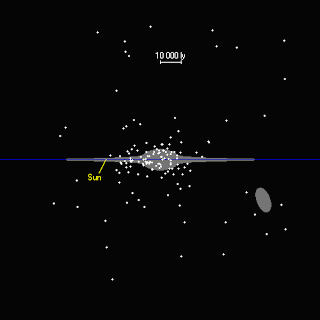
Of the globular clusters within our Milky Way, the majorities are found in the vicinity of the galactic core, and the large majorities lie on the side of the celestial sky centered on the core.

In 1918 this strongly asymmetrical distribution was used by Harlow Shapley to make a determination of the overall dimensions of the galaxy. By assuming a roughly spherical distribution of globular clusters around the galaxy's center, he used the positions of the clusters to estimate the position of the sun relative to the galactic center. While his distance estimate was significantly in error, it did demonstrate that the dimensions of the galaxy were much greater than had been previously thought. His error was due to the fact that dust in the Milky Way diminished the amount of light from a globular cluster that reached the earth, thus making it appear farther away. Shapley's estimate was, however, within the same order of magnitude of the currently accepted value.

Shapley's measurements also indicated that the Sun was relatively far from the center of the galaxy, contrary to what had previously been inferred from the apparently nearly even distribution of ordinary stars. In reality, ordinary stars lie within the galaxy's disk and are thus often obscured by gas and dust, whereas globular clusters lie outside the disk and can be seen at much further distances.

Shapley was subsequently assisted in his studies of clusters by Henrietta Swope and Helen Battles Sawyer (later Hogg). In 1927–29, Harlow Shapley and Helen Sawyer began categorizing clusters according to the degree of concentration the system has toward the core. The most concentrated clusters were identified as Class I, with successively diminishing concentrations ranging to Class XII. This became known as the Shapley–Sawyer Concentration Class.

Globular clusters are generally composed of hundreds of thousands of low-metal, old stars. The types of stars found in a globular cluster are similar to those in the bulge of a spiral galaxy but confined to a volume of only a few cubic parsecs. They are free of gas and dust and it is presumed that all of the gas and dust was long ago turned into stars.

While globular clusters can contain a high density of stars (on average about 0.4 stars per cubic parsec, increasing to 100 or 1000 stars per cubic parsec in the core of the cluster),[14] they are not thought to be favorable locations for the survival of planetary systems. Planetary orbits are dynamically unstable within the cores of dense clusters because of the perturbations of passing stars. A planet orbiting at 1 astronomical unit around a star that is within the core of a dense cluster such as 47 Tucanae would only survive on the order of 108 years

Globular clusters have a very high star density, and therefore close interactions and near-collisions of stars occur relatively often. Due to these chance encounters, some exotic classes of stars, such as blue stragglers, millisecond pulsars and low-mass X-ray binaries, are much more common in globular clusters. A blue straggler is formed from the merger of two stars, possibly as a result of an encounter with a binary system. The resulting star has a higher temperature than comparable stars in the cluster with the same luminosity, and thus differs from the main sequence stars formed at the beginning of the cluster

The ages of globular clusters place a bound on the age limit of the entire universe. This lower limit has been a significant constraint in cosmology. During the early 1990s, astronomers were faced with age estimates of globular clusters that appeared older than cosmological models would allow. However, better measurements of cosmological parameters through deep sky surveys and satellites such as COBE have resolved this issue as have computer models of stellar evolution that have different models of mixing.

Hopefully we will have some clear skies and be able to see some of these ancient star groups.