New- Star Chart For Cayman

A new feature as of June 2015 has been added - look at the bottom of this web page and there is a new Star Chart exclusively for Grand Cayman

20 December 2009, 6.30 p.m.


We will meet on Sunday, 20th 6.30 p.m. at the end of Windward Street in North Sound Estates.


On 16 December 2009, the European Space Agency (ESA) reported that the Herschel Space Observatory has peered inside an unseen stellar nursery and revealed surprising amounts of activity. Some 700 newly-forming stars are estimated to be crowded into filaments of dust stretching through the image.


The image above shows a dark cloud 1000 light-years away in the constellation Aquila, the Eagle. It covers an area 65 light-years across and is so shrouded in dust that no previous infrared satellite has been able to see into it. Now, thanks to Herschel’s superior sensitivity at the longest wavelengths of the infrared, astronomers have their first picture of the interior of this cloud.
Embedded within the dusty filaments in the Aquila image are 700 condensations of dust and gas that will eventually become stars. Astronomers estimate that about 100 are protostars, celestial objects in the final stages of formation. Each one just needs to ignite nuclear fusion in its core to become a true star. The other 600 objects are insufficiently developed to be considered protostars, but these too will eventually become another generation of stars.


This cloud is part of Gould’s Belt, a giant ring of stars that circles the night sky – the Solar System just happens to lie near the centre of the belt. The first to notice this unexpected alignment, in the mid-19th century, was England’s John Herschel, the son of William, after whom ESA’s Herschel telescope is named. But it was Boston-born Benjamin Gould who brought the ring to wider attention in 1874.

Gould’s Belt supplies bright stars to many constellations such as Orion, Scorpius, Canis Major, Puppis, Carina, Centaurus, and Crux, and conveniently provides nearby star-forming locations for astronomers to study. Observing these stellar nurseries is a key programme for Herschel, which aims to uncover the demographics of star formation and its origin, or in other words, the quantities of stars that can form and the range of masses that such newborn stars can possess. Apart from this region of Aquila, Herschel will target 14 other star-forming regions as part of the Gould’s Belt Key Programme.

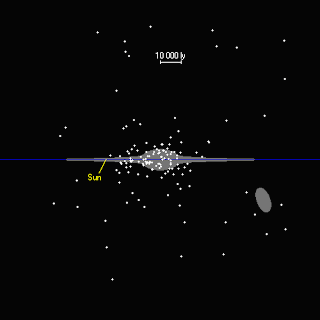
More recent observations have established that the Gould Belt is a key structural feature of the Orion Arm, the region of the Milky Way Galaxy in which we live. It is an elliptical disk of hydrogen and other gases, inclined to the plane of the larger Galactic disk by an angle of about 17.2 degrees. Its long axis is about 750 parsecs, and its short axis is about 470 parsecs. Its age is estimated as 30 to 50 million years. In astronomical terms, therefore, the Gould Belt is a very young formation -- much more recent, for example, than the Jurassic Period (145-200 million years ago), when large dinosaurs roamed the Earth.

A recent theory is that the Gould Belt formed about 30 million years ago when a blob of dark matter collided with the molecular cloud in our region. There is also evidence for similar Gould belts in other galaxies.

The second full moon of December will fall on New Years Eve, a big, bright Blue Moon. A blue moon is a full moon that is not timed to the regular monthly pattern. Most years have twelve full moons which occur approximately monthly, but in addition to those twelve full lunar cycles, each calendar year contains an excess of roughly eleven days. The extra days accumulate, so that every two or three years (on average about every 2.7154 years), there is an extra full moon.


Thursday, 19th November, 6.30. p.m Pedros Castle


The meeting will be very dependent on the Weather - meeting will be cancelled if greater than 50 percent cloud cover. If in doubt on the Weather at Pedros ring Nick Kelly on 9473065
However lets be optimistic.


When darkness falls, on the 19th, the sky will look like the diagram above.
In the south, shines one of the brightest stars in the sky, Fomalhaut, brightest star in the constellation Piscis Austrinus.
Piscis Austrinus (also known as Piscis Australis) is a constellation in the southern celestial hemisphere. The name is Latin for "the southern fish" in contrast with the larger constellation Pisces, which represents a pair of fishes.
In Greek mythology, this constellation is known as the Great Fish and it is portrayed as swallowing the water being poured out by Aquarius, the water-bearer constellation. The two fish of the constellation Pisces are said to be the offspring of the Great Fish. In Egyptian mythology, this fish saved the life of the Egyptian goddess Isis, so she placed this fish and its descendants into the heavens as constellations of stars. Fomalhaut traditionally represents the mouth of the fish.


Fomalhaut means "mouth of the whale", from the Arabic. It is a class A star on the main sequence approximately 25 light-years from Earth. It is classified as a Vega-like star that emits excess infrared radiation, indicating it is surrounded by a circumstellar disk.
Fomalhaut holds a special significance in extrasolar planet research, as it is the center of the first stellar system with an extrasolar planet (Fomalhaut b) imaged at visible wavelengths. The image was published in Science in November 2008.[2]
Fomalhaut is believed to be a young star, only 100 to 300 million years old, with a potential lifespan of a billion years. The surface temperature of the star is around 8,751 K (15,292 °F; 8,478 °C). Compared to the Sun, its mass is about 2.1, its luminosity is about 18, and its diameter is roughly 1.8. Fomalhaut has a slightly lower proportion of elements with higher atomic numbers than helium: about 79% as much as the Sun.
Fomalhaut is a member of the 16 stars belonging to the Castor Moving Group. This is an association of stars that shares a common motion through space and are therefore likely to be physically associated. Other members of this group include Castor and Vega. This moving group has an estimated age of 200 ± 100 million years and originated from the same location. The nearby star TW Piscis Austrini, a member of this group, may form a physical pair with Fomalhaut.
On November 13, 2008, astronomers announced the discovery of an extrasolar planet orbiting just inside the debris ring. This was the first extrasolar planet to be seen with visible light, captured by the Hubble Space Telescope. The planet's existence had been previously suspected from the sharp, elliptical inner edge of Fomalhaut's debris disk. The mass of the planet, Fomalhaut b, is estimated to be no more than three times the mass of Jupiter and at least the mass of Neptune.


21st October 2009, 6.30 at Pedro Castle

In Capricornus, the planet Jupiter outshines all the faint stars in what is the second faintest constellation in the zodiac after Cancer.

The illustration above is approximate size comparison of Earth and Jupiter, including the Great Red Spot. The Great Red Spot, a persistent anticyclonic storm located 22° south of the equator is larger than Earth. It is known to have been in existence since at least 1831, and possibly since 1665. Mathematical models suggest that the storm is stable and may be a permanent feature of the planet. The storm is large enough to be visible through Earth-based telescopes with an aperture of 12 cm or larger.

The oval object rotates counterclockwise, with a period of about six days. The Great Red Spot's dimensions are 24–40,000 km × 12–14,000 km. It is large enough to contain two or three planets of Earth's diameter.

Jupiter is the fifth planet from the Sun and the largest planet within the System. It is a gas giant with a mass slightly less than one-thousandth that of the Sun but is two and a half times the mass of all of the other planets in our Solar System combined. Jupiter is classified as a gas giant along with Saturn, Uranus and Neptune. Together, these four planets are sometimes referred to as the Jovian planets.

The planet was known by astronomers of ancient times and was associated with the mythology and religious beliefs of many cultures. The Romans named the planet after the Roman god Jupiter. When viewed from Earth, Jupiter can reach an apparent magnitude of −2.8, making it on average the third-brightest object in the night sky after the Moon and Venus. (Mars can briefly exceed Jupiter's brightness at certain points in its orbit.)

Jupiter is primarily composed of hydrogen with a quarter of its mass being helium; it may also have a rocky core of heavier elements. Because of its rapid rotation, Jupiter's shape is that of an oblate spheroid (it possesses a slight but noticeable bulge around the equator). The outer atmosphere is visibly segregated into several bands at different latitudes, resulting in turbulence and storms along their interacting boundaries. A prominent result is the Great Red Spot. Surrounding the planet is a faint planetary ring system and a powerful magnetosphere. There are also at least 63 moons, including the four large moons called the Galilean moons that were first discovered by Galileo Galilei in 1610. Ganymede, the largest of these moons, has a diameter greater than that of the planet Mercury.

The planet has been explored on several occasions by robotic spacecraft, most notably during the early Pioneer and Voyager flyby missions and later by the Galileo orbiter. The most recent probe to visit Jupiter was the Pluto-bound New Horizons spacecraft in late February 2007. The probe used the gravity from Jupiter to increase its speed. Future targets for exploration in the Jovian system include the possible ice-covered liquid ocean on the moon Europa.

Jupiter has been called the Solar System's vacuum cleaner because of its immense gravity well and location near the inner Solar System. It receives the most frequent comet impacts of the Solar System's planets. It was thought that the planet served to partially shield the inner system from cometary bombardment. However, recent computer simulations suggest that Jupiter doesn't cause a net decrease in the number of comets that pass through the inner Solar System, as its gravity perturbs their orbits inward in roughly the same numbers that it accretes or ejects them. This topic remains controversial among current astronomers, as some believe it draws comets towards Earth from the Kuiper Belt while others believe that Jupiter protects Earth from the alleged Oort Cloud.

A 1997 survey of historical astronomical drawings suggested that the astronomer Cassini may have recorded an impact scar in 1690. During the period July 16, 1994 to July 22, 1994, over 20 fragments from the comet Shoemaker-Levy 9 collided with Jupiter's southern hemisphere, providing the first direct observation of a collision between two Solar System objects. This impact provided useful data on the composition of Jupiter's atmosphere.

On July 19, 2009, an impact site was discovered at approximately 216 degrees longitude in System 2. This impact left behind a black spot in Jupiter's atmosphere, similar in size to Oval BA. Infrared observation showed a bright spot where the impact took place, meaning the impact warmed up the lower atmosphere in the area near Jupiter's south pole.

Pedro Castle,2009, September 21st, 7.00 p.m.

The summer was literally a washout for observing,but we're back.

The diagram above shows the night sky at viewing time. Jupiter is brilliant in the south-east. Further to the north can be found the constellation Lyra which is easily identified by using the bright star Vega, which is one of the brightest in the sky.

In Lyra, the name of which is derived from the lyre, a stringed musical instrument well known for its use in classical antiquity and later, can be found M56, a rather loose globular cluster at a distance of approximately 32,900 light-years, with a diameter of about 85 light years.


A globular cluster is a spherical collection of stars that orbits a galactic core as a satellite. Globular clusters are very tightly bound by gravity, which gives them their spherical shapes and relatively high stellar densities toward their centers. The name of this category of star cluster is derived from the Latin globulus—a small sphere. A globular cluster is sometimes known more simply as a globular.

Globular clusters, which are found in the halo of a galaxy, contain considerably more stars and are much older than the less dense galactic, or open clusters, which are found in the disk. Globular clusters are fairly common; there are about 158 currently known globular clusters in the Milky Way, with perhaps 10 to 20 more still undiscovered. Large galaxies can have more: Andromeda, for instance, may have as many as 500. Some giant elliptical galaxies, such as M87, may have as many as 10,000 globular clusters. These globular clusters orbit the galaxy out to large radii, 40 kilo parsecs (approximately 131,000 light-years) or more.

Although it appears that globular clusters contain some of the first stars to be produced in the galaxy, their origins and their role in galactic evolution are still unclear.

The first globular cluster discovered was M22 in 1665 by Abraham Ihle, a German amateur astronomer. However, given the small aperture of early telescopes, individual stars within a globular cluster were not resolved until Charles Messier observed M4

Beginning in 1914, Harlow Shapley began a series of studies of

globular clusters, published in about 40 scientific papers. He examined the cepheid variables in the clusters and would use their period–luminosity relationship for distance estimates.

Of the globular clusters within our Milky Way, the majorities are found in the vicinity of the galactic core, and the large majorities lie on the side of the celestial sky centered on the core.

In 1918 this strongly asymmetrical distribution was used by Harlow Shapley to make a determination of the overall dimensions of the galaxy. By assuming a roughly spherical distribution of globular clusters around the galaxy's center, he used the positions of the clusters to estimate the position of the sun relative to the galactic center. While his distance estimate was significantly in error, it did demonstrate that the dimensions of the galaxy were much greater than had been previously thought. His error was due to the fact that dust in the Milky Way diminished the amount of light from a globular cluster that reached the earth, thus making it appear farther away. Shapley's estimate was, however, within the same order of magnitude of the currently accepted value.

Shapley's measurements also indicated that the Sun was relatively far from the center of the galaxy, contrary to what had previously been inferred from the apparently nearly even distribution of ordinary stars. In reality, ordinary stars lie within the galaxy's disk and are thus often obscured by gas and dust, whereas globular clusters lie outside the disk and can be seen at much further distances.

Shapley was subsequently assisted in his studies of clusters by Henrietta Swope and Helen Battles Sawyer (later Hogg). In 1927–29, Harlow Shapley and Helen Sawyer began categorizing clusters according to the degree of concentration the system has toward the core. The most concentrated clusters were identified as Class I, with successively diminishing concentrations ranging to Class XII. This became known as the Shapley–Sawyer Concentration Class.

Globular clusters are generally composed of hundreds of thousands of low-metal, old stars. The types of stars found in a globular cluster are similar to those in the bulge of a spiral galaxy but confined to a volume of only a few cubic parsecs. They are free of gas and dust and it is presumed that all of the gas and dust was long ago turned into stars.

While globular clusters can contain a high density of stars (on average about 0.4 stars per cubic parsec, increasing to 100 or 1000 stars per cubic parsec in the core of the cluster),[14] they are not thought to be favorable locations for the survival of planetary systems. Planetary orbits are dynamically unstable within the cores of dense clusters because of the perturbations of passing stars. A planet orbiting at 1 astronomical unit around a star that is within the core of a dense cluster such as 47 Tucanae would only survive on the order of 108 years

Globular clusters have a very high star density, and therefore close interactions and near-collisions of stars occur relatively often. Due to these chance encounters, some exotic classes of stars, such as blue stragglers, millisecond pulsars and low-mass X-ray binaries, are much more common in globular clusters. A blue straggler is formed from the merger of two stars, possibly as a result of an encounter with a binary system. The resulting star has a higher temperature than comparable stars in the cluster with the same luminosity, and thus differs from the main sequence stars formed at the beginning of the cluster

The ages of globular clusters place a bound on the age limit of the entire universe. This lower limit has been a significant constraint in cosmology. During the early 1990s, astronomers were faced with age estimates of globular clusters that appeared older than cosmological models would allow. However, better measurements of cosmological parameters through deep sky surveys and satellites such as COBE have resolved this issue as have computer models of stellar evolution that have different models of mixing.

Hopefully we will have some clear skies and be able to see some of these ancient star groups.


Pedro Castle, June 25th. 7.30 p.m. 2009

Close to the zenith and easily identifiable is the bright star Spica, which is the alpha star in the constellation Virgo.
Virgo is one of the constellations of the zodiac. Its name is Latin for virgin,). Lying between Leo to the west and Libra to the east, it is the second largest constellation in the sky.
Because of the presence of a galaxy cluster (consequently called the Virgo cluster) within its borders), this constellation is especially rich in galaxies.
Illustrated above, some examples are Messier 49 (elliptical), Messier 58 (spiral), Messier 59 (elliptical), Messier 60 (elliptical), Messier 61 (spiral), Messier 84 (lenticular), Messier 86 (lenticular), Messier 87 (elliptical and a famous radio source), Messier 89 (elliptical) and Messier 90 (spiral).
A noted galaxy that is not part of the cluster is the Sombrero Galaxy (M104), an unusual spiral galaxy. It is located about 10° due west of Spica.
Spica (also known as α Vir / α Virginis / Alpha Virginis) is the 15th brightest star in the nighttime sky. It is 260 light years distant from Earth. A blue giant, it is a variable of the Beta Cephei type.

Who exactly Virgo was considered to represent is uncertain; in history, it has been associated with nearly every prominent goddess, including Ishtar, Isis, Cybele, and Athena, as well as with Mary the Mother of Jesus.
Persephone (who in some mythologies, notably the Eleusinian Mysteries, was considered to be a form of Demeter) is often mentioned as well, Virgo being visible mainly in the spring months when she was believed to have risen from the underworld.
According to one interpretation, the constellation depicts Astraea, the virgin daughter of the god Zeus and the goddess Themis. Astraea was known as the goddess of justice, and was identified as this constellation due to the presence of the scales of justice Libra nearby, and supposedly ruled the world at one point with her wise ways until mankind became so callous she returned to the skies disgusted.
Saturn is visible as darkness falls, but for the other planets you will either stay up late, to see Jupiter, which rises after 10 pm, or get up before dawn to see Venus and Mars.

Pedro Castle,May 27th, 2009, 7.30 p.m.


In the rainy season the decision whether or not to view is determined by the amount of cloud cover. If more than 50% of the sky is obscured, we cancel. This can sometimes be a difficult judgment call.
The constellation illustrated above is Leo, the Lion, which is visible overhead as darkness falls. The sickle shape, or backwards question mark with the bright star Regulus at its base, is easy to discern.
Brighter Saturn is below the question mark.
Regulus, which means the heart of the lion, is a hot, blue star which has a luminosity about 140 times that of the Sun and about 3.4 times the diameter. The star is in fact the A component of a multiple star system. The B and C components are a close binary pair revolving together about 100 AU (Astronomical Unit) from the A star. This is two and a half time the distance of Pluto and the Sun.
The Sumerians are recorded as seeing this group of stars as a lion. The form of the Lion was probably passed along to the Babylonians, Greeks, Roman and others. The Egyptians worshipped the lion because the sun was in this constellation at the time of the life-giving floods of the Nile.
In Greek mythology, it was identified as the Nemean Lion which was killed by Herakles during one of his twelve labours, and subsequently put into the sky by the goddess Hera, the vengeful wife of his father, Zeus.

Pedro Castle,April 28th, 7.00 p.m.


The zenith at 7 on Tuesday will be just across the boundary line separating Gemini from Cancer, the constellation illustrated above.
Cancer, the Crab, plays a minor role in the Twelve Labors of Hercules. While Hercules was busy fighting the multi-headed monster, Hydra, the goddess Hera, who did not like Hercules, sent the Crab to distract him. Cancer grabbed onto the hero's toe with its claws, but barely breaking the rhythm of his great battle with Hydra, Hercules crushed the crab with his foot. Hera, grateful for the little crustacean's heroic but pitiful effort, gave it a place in the sky.
Cancer is famous despite itself due to its Zodiacal origins. In fact, it is very faint with no stars brighter than 4th magnitude. However, it is home to Praesepe (M44), an open cluster also called the Beehive Cluster or the Gate of Men. In the picture above, it is the star marked next to the lower eyestalk. It is one of the nearest open clusters to the Solar System, and it contains a larger star population than most other nearby clusters. Under dark skies the Beehive Cluster looks like a nebulous object to the naked eye; thus it has been known since ancient times.

Like many star clusters of all kinds, Praesepe has experienced mass segregation. This means that bright, massive stars are concentrated in the cluster's core, while dimmer, less massive stars populate its halo (sometimes called the "corona"). The cluster's core radius is estimated at 3.5 parsecs (11.4 light years); its half-mass radius is about 3.9 parsecs (12.7 light years); and its tidal radius is about 12 parsecs (39 light years). However, the tidal radius also includes many stars that are merely "passing through" and not bona fide cluster members.
Altogether, the Praesepe cluster contains at least 1000 gravitationally bound stars, for a total mass of about 500-600 Solar masses. A recent survey counts 1010 high-probability members, of which 68% are M dwarfs, 30% are Sun-like stars of spectral classes F, G, and K, and about 2% are bright stars of spectral class A. Also present are five giant stars, four of which have spectral class K0 III and the fifth G0 III.
So far, eleven white dwarfs have been identified, representing the final evolutionary phase of the cluster's most massive stars, which originally belonged to spectral type B. Brown dwarfs, however, are extremely rare in this cluster, probably because they have been lost by tidal stripping from the halo.
Galileo was one of the first to study this open cluster with optical aid and counted forty stars.
Praesepe is Latin meaning crib or manger. Some ancient lore is associated with it: Greeks and Romans saw this "nebula" as the manger (Greek: Phatne) associated with two asses who eat from it, Asellus Borealis, the Northern Ass and Asellus Australis, the Southern Ass. Erathosthenes reported that these were the asses on which the gods Dionysos and Silenus rode into the battle against the Titans, who were frightened by the animals' braying so that the gods won. As a reward, the asses were put in sky together with Phatne.
The wine must have been good in ancient Greece.
Aratos (260 B.C.) mentioned this object as "Little Mist", Hipparchus (130 B.C.) included this object in his star catalog and called it "Little Cloud" or "Cloudy Star." Ptolemy, the Roman[1] mathematician, astronomer, geographer and astrologer mentions it as one of seven "nebulae" he noted in his Almagest.
According to the new determination by ESA's astrometric satellite Hipparcos, the cluster is 577 light years distant (previous estimates have been at 522 light years), and its age was estimated at about 730 million years.
Open clusters are physically related groups of stars held together by mutual gravitational attraction. Therefore, they populate a limited region of space, typically much smaller than their distance from us, so that they are all roughly at the same distance. They are believed to originate from large cosmic gas and dust clouds (diffuse nebulae) in the Milky Way, and to continue to orbit the galaxy through the disk. In many clouds visible as bright diffuse nebulae, star formation still takes place at this moment, so that we can observe the formation of new young star clusters. The process of formation takes only a considerably short time compared to the lifetime of the cluster, so that all member stars are of similar age. Also, as all the stars in a cluster formed from the same diffuse nebula, they are all of similar initial chemical composition.
Saturn is in the constellation Leo, shining in bright competition with Regulus.