New- Star Chart For Cayman

A new feature as of June 2015 has been added - look at the bottom of this web page and there is a new Star Chart exclusively for Grand Cayman

Pedro Castle,Tuesday, 8th April

Bright, ruddy Mars will be overhead in the middle of the constellation Gemini, approximately by Castor’s hand.
Castor is a visual double star made up of two blue-white stars, A and B, of 1.9 and 2.9 magnitudes respectively. The pair orbit each other every 400 years and are now as close as they ever get, making them somewhat of a challenge to split and requiring good seeing. In fact their spectra show that each is itself a double star. Castor A is made up of two identical 2 solar mass stars orbiting each other every 9.2 days while the stars that make up Castor B orbit even faster, every 2.9 days.
Pollux is one of few stars visible to the naked eye which features an extrasolar planet.


Saturn will be in the east as darkness falls, very close to the star Regulus, the heart of the Lion, Leo.
Regulus is the brightest star in the constellation Leo and one of the brightest stars in the nighttime sky. Regulus is approximately 77.5 light years from Earth.
Regulus has about 3.5 times the Sun’s mass and is a young star of only a few hundred million years. It is spinning extremely rapidly, with a rotation period of only 15.9 hours, which causes it to have a highly oblate shape. This results in so-called gravity darkening: the photosphere at Regulus' poles is considerably hotter, and five times brighter per unit surface area, than its equatorial region. If it were rotating only 16% faster, centripetal force would overcome gravity and the star would tear itself apart.
Regulus is a multiple star system composed of a hot, bright, bluish-white star with a pair of small, faint companions. The pair orbits the much-larger Regulus A with a period of over 130,000 years at a distance of some 4,200 AU. The companion pair have an orbital period of 2,000 years and are separated by about 100 AU.

Pedro Castle, Monday March 10th, 7.00 p.m.

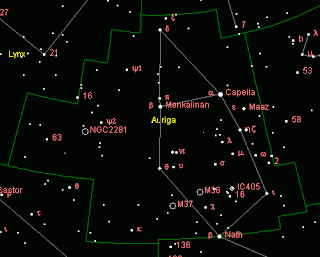
High overhead at viewing time lies the constellation Auriga.
The Charioteer (possibly Erechthonius, son of Vulcan) is among the brightest northern constellations, it lies midway between Perseus and Ursa Major in a region crossed by the Milky Way, and is the site of the galactic anticenter (the point in the sky diametrically opposite the center of the Galaxy). Gamma Aur, or El Nath, is shared with Taurus and is universally referred nowadays as Beta Tau.
Its brightest star is Capella, which is associated with the mythological she-goat Amalthea. The three stars ε Aurigae, ζ Aurigae and η Aurigae are called Haedi (the Kids). Aurigae and Zeta Aurigae are remarkable eclipsing binaries.
ε Aurigae and ζ Aurigae are peculiar binary stars. The orbital period of ε Aurigae is approximately 27 years, with an eclipse duration of about 18 months. The visible companion is a yellowish F-class supergiant. The type of the other star is not known. ζ Aurigae has a period of 970 days, the primary is a K-class supergiant and the secondary is a B-class main sequence star. Both these systems present a rare stage of binary evolution, as the components are in a short and active evolutionary stage.
Auriga has many open clusters and other objects because the Milky Way runs through it. The three brightest open clusters are M36, M37 and M38, all of which are visible in binoculars or a small telescope in suburban skies. A larger telescope resolves individual stars. The clusters are about 4100, 4400, and 4200 light years distant, respectively. Their apparent visual magnitudes are 6.3, 6.2, and 7.4, respectively.
Capella (α Aur / α Aurigae / Alpha Aurigae) is the brightest star in the constellation, and eleventh brightest star in the sky. Although it appears as a single point to the naked eye, Capella is actually a bright close binary pair of yellow giant stars along side a second, fainter binary.
A yellow star, it traditionally marks the left shoulder of the constellation's eponymous charioteer, or sometimes the goat that the charioteer is carrying. It is closer to the north celestial pole than any other first magnitude star (Polaris is only second magnitude) and as a result has played a significant role in many mythological writings. A tablet dating back to 2000 BC refers to Capella.
Astronomically, Capella's interest lies in the fact that it is an easily-studied non-eclipsing spectroscopic binary star. These two giant G-class stars have luminosities of around 50 and 80 times that of the Sun and lie less than 100 million km apart with an orbital period of 104.02 days. The stars were probably of spectral class A during their main sequence, similar to Sirius, and are in the process of becoming red giants in a few million more years as they continue to expand, cool, and brighten. Capella is a source of X-rays, probably due to surface magnetic activity on one of the pair. The Capella binary was the first star system to be imaged using a long baseline optical astronomical interferometer in observations by COAST in 1995.
The central stars also have a faint companion that is itself a double star, consisting of two M-class red dwarf stars, that orbit at around a light year away from the main pair.
In Australian Aboriginal mythology, Capella was Purra, the kangaroo, pursued and killed by the nearby Gemini twins or by the Orion hunter, or near the Orion belt twins canoe.
To the Bedouin people of the Negev and Sinai, Capella is known as al-'Ayūg, 'the dandy', in its role as pointing out the position of the Pleiades -its name more fully al-'Ayūg ath-Thurayyā 'dandy of the Pleiades'.

On the night,Mars will be high overhead, with Saturn rising in the east, close to the brightest star in Leo, Regulus.
clear skies
Nick

Pedro Castle, Monday February 11th

As darkness falls on Monday the bright star Aldebaran can be seen directly overhead.
Aldebaran is the brightest star in the constellation Taurus and one of the brightest stars in the nighttime sky. It has the Bayer designation Alpha Tauri. Because of its location in the head of Taurus, it has historically been called the Bull's Eye. Aldebaran has the appearance of being the brightest member of the more scattered Hyades cluster, which is the closest star cluster to Earth. However, it is merely located in the line of sight between the Earth and the Hyades, and is actually an independent star.
In 1997, a possible substellar companion was reported, with a mass at least 11 times that of Jupiter with an orbital period of around 2 years, however this has not been confirmed.
Aldebaran is a K5 III star, which means it is orangish, large, and has moved off of the main sequence after exhausting the hydrogen fuel in its core. It has a minor companion (a dim M2 dwarf orbiting at several hundred AU). Now primarily fusing helium, the main star has expanded to a diameter of approximately 5.3 × 10⁷ km, or about 38 times the diameter of the Sun.
The Hipparcos satellite has measured it as 65.1 light years away, and it shines with 150 times the Sun's luminosity. With an apparent magnitude of 0.87, it is the 14th brightest star.
The name Aldebaran comes from the Arabic (الدبران al-dabarān) meaning "the follower" and refers to the way the star follows the Pleiades star cluster in its nightly journey across the sky.
In Persia it was known as Satvis and Kugard.[4]
It is known as 畢宿五 (Bìxiùwŭ, the Fifth Star of the Net) in Chinese.
Aldebaran is identified as the lunar mansion Rohini in Hindu astronomy and as one of the twenty-seven daughters of Daksha and the wife of the god Chandra.
The Romans called it Palilicium.
For the Dakotas (a branch of the Native American Sioux tribe), Aldebaran took on a heroic aspect. The young star was the child of the sun and the lady Blue Star. One day, he desired to hunt the white buffalo (the Pleiades). After he pulled up a sapling to make a spear, a hole was made in the ground and he could see all the people of Earth down below. The white buffalo took this chance to push him through. He was found by an old woman and was to be known as Old Woman's Grandson. On Earth, he killed many strange monsters that had been troubling the Native Americans; one monster of which was a serpent that caused drought. The young hero killed the serpent, releasing a great stream of water that became the Mississippi River. In time, Old Woman's Grandson remembered the white buffalo and returned to hunting him in the sky to fulfill his destiny.
For the Seris of northwestern Mexico, this star is providing light for the seven women giving birth (Pleiades).
Noticeably redder, and brighter, is the nearby planet Mars.
Mars is close to the β (beta) star of Auriga on the illustration above.
Called Menkalinan, it is a double star consisting of two blue white giant A2 class stars. They have magnitudes of 1.9 and 2.7 and are 90 light years distant.

January 11th 2008


Although the eye is drawn to bright Mars and the rising winter constellations, almost directly overhead as darkness falls is the small, faint constellation of Aries.
Aries is one of the least conspicuous of the zodiacal constellations, and has only two stars above third magnitude. These are Hamal and Sheratan, the Alpha and Beta stars of the constellation. Unusually, these two stars not only appear to be close together in the sky, but actually are: they lie just six light years from one another.
The Hipparcos satellite indicates that Hamal is about 65.9 light-years from Earth. Combined with its intrinsic brightness, this relatively small distance makes the star shine at an apparent magnitude of 2.01, the 47th brightest star in the sky.
Beta Arietis is the Ram's second horn. It also has the traditional name Sharatan (or Sheratan or Sheratim), and the Flamsteed designation 6 Arietis.
Al Sharatan means "the two signs", a reference to the star having marked the vernal equinox together with its binary partner Gamma Arietis several thousand years ago. It is 59.6 light years from Earth.
Gamma Arietis, Mesarthrim, shines third among the stars of the flat triangle that make the classical figure of Aries, the Ram (for that reason gaining the Gamma designation). The name (derived from Arabic) originally came from the same root as that for the Beta star, Sheratan (meaning "the two"), but was corrupted by mistranslations into its current form.
Gamma Arietis is a beautiful double star, which was discovered quite by chance in 1664 when astronomer, Robert Hooke, was following the motion of a comet. Gamma Arietis is one of the earliest double stars on record to have been found with the aid of a telescope.
Teegarden's star, a recent (2003) discovery is also in the constellation. It is one of Sun's closest neighbors at around 12 light years away. It appears to be a red dwarf, a class of low temperature and low luminosity stars. This would explain why it was not discovered earlier, since it has an apparent magnitude of only 15.4 (and an absolute magnitude of 17.47).
Teegarden's Star was discovered on images taken by the NEAT program operated by NASA. Its name comes from its principal discoverer, Dr. Bonnard Teegarden, an astrophysicist at NASA's Goddard Space Flight Center.
It is thought to be quite likely that many other dim and easily overlooked red dwarf stars exist in the nearest 20 light years, as stellar population surveys show their count to be quite lower than otherwise expected.
Although dim, Aries is one of the oldest and most revered of all constellations. The ancient Babylonians, Egyptians, Persians and Greeks all called this group of stars "The Ram." It is the Zodiac's first constellation since the Sun, at one time, was entering Aries on the day of the vernal equinox...the moment when it crosses from the southern to the northern half of the celestial sphere. However, because of the Earth's precession, the Sun is now in Pisces at the vernal equinox. Nevertheless, Aries is still considered to be the symbolic first constellation of the Zodiac and Right Ascension continues to be measured from the first point of Aries.
In a bygone age, the Egyptians associated Aries with Amon-Re, the ram-headed supreme Sun God who symbolized power and fertility. The Mesopotamians' name for the constellation meant a military leader or prince. In Hebrew tradition, the ram represented the death-defying blood of the lamb smeared on the doorways as part of the original Passover, which preceded the Hebrew Exodus from Egypt. The Greeks related Aries to the story of the Golden Fleece, the hide of the flying ram that Jason (with the help of his beloved Medea) spirited away from the serpent in the Grove of Aries. This constellation is mentioned in "Phaenomena," authored by the Greek poet Aratus, which dates from the Third Century B.C., and Ptolemy, the great astronomer who lived and worked in Egypt during the Second Century A.D., cataloged this constellation.
The present name of this Zodiac Sign is Roman in origin, Roman mythology having been adopted from that of the Ancient Greeks. This faint and tiny cluster of stars first appeared on monetary coin in 6 A.D.
clear skies
Nick

Wednesday, 12th December 6.30 p.m.


Directly over head as darkness fall is the constellation Pegasus. Four stars form almost a perfect square that are about the same brightness. This is the "Great Square of Pegasus."
The "Great Square" forms the body of the Winged Horse. To connect the rest of Pegasus, you'll need to use the right side of the "square." Pegasus is flying upside down across the sky. From Markab (lower right corner) extends the head of the Winged Horse. The two front legs of Pegasus can be found off the star Scheat (upper right corner). The star Alpheratz is shared by two constellations, Pegasus and Andromeda. The star is actually considered to be a star of Andromeda.
51 Pegasi, a star in this constellation, is the first Sun-like star known to have an extrasolar planet. IK Pegasi is the nearest supernova candidate.
In Andromeda is the most famous deep sky object , M31.This is the Andromeda Galaxy, one of the most distant objects visible to the naked eye. It is an enormous spiral galaxy much like the Milky Way and is approximately 2.5 million light-years away.
Andromeda is the largest galaxy of the Local Group, which consists of the Andromeda Galaxy, the Milky Way Galaxy, the Triangulum Galaxy, and about 30 other smaller galaxies. Although the largest, it may not be the most massive, as recent findings suggest that the Milky Way contains more dark matter and may be the most massive in the grouping. However, recent observations by the Spitzer Space Telescope revealed that M31 contains one trillion (1012) stars, greatly exceeding the number of stars in our own galaxy. 2006 estimates put the mass of the Milky Way to be ~80% of the mass of Andromeda, which is estimated to be 7.1×10¹¹ solar masses.
Bright Mars rises a little later that night, making its closest approach to Earth since 2005. Not often do we get a close look at Mars. It’s a small world to begin with, about half the diameter of Earth, and it spends most of the time far away on the other side of its orbit from us. Mars usually ranks as one of the most disappointing objects in amateur astronomy — a tiny, featureless orange blob. The only time we get a decent look at its surface markings, clouds, dust storms, and changing polar caps is for a couple of months every two years, when Mars comes closest (around its date of opposition).
This time around, Mars maxes out at 15.9 arcseconds when it passes closest to Earth on December 18th. That's nowhere near its record-breaking apparent diameter of 25.1" in August 2003. Even so, it's bigger than Mars will appear again until 2016.
Contrary to rumor, Comet 17P/Holmes has not faded away. From any dark starry-skied observing site, it remains visible to the naked eye. Although the comet is not as bright as it was when it exploded in late October, it makes up for its lack of surface brightness by sheer size: the comet is huge! It looks like a faint Moon-sized puff of cloud in the middle of the constellation Perseus--a really splendid sight.
For patient and wakeful people, the Geminid meteor shower can be viewed the night of December 13–14, with good prospects the following night as well.

Monday 12th November Pedros Castle 6:30 PM

There are few bright stars in the sky this time of year, which makes it difficult to easily make out many of the constellations.
However, one of the most distinctive constellations in the northern hemisphere, Cassiopeia, the vain Queen, is in the north when it is dark.
Cassiopeia, the wife of King Cepheus, ruler of Aethiopia, was beautiful, arrogant and vain, and it was these latter two characteristics which were to lead to her downfall. Her continual boast that both she and her daughter Andromeda were more beautiful than the sea nymphs, daughters of Nereus, the sea god, brought the wrath of Poseidon, ruling god of the sea, upon the kingdom of Aethiopia. Trying to avert such a fate, Cepheus and Cassiopeia consulted a wise oracle, who told them that the only way to appease the sea gods was to sacrifice their daughter. Accordingly, Andromeda was chained to a rock at the sea's edge, and left there to helplessly await her fate at the mercy of the sea monster. But Perseus arrived in time and saved Andromeda. Poseidon considered that Cassiopeia should not escape punishment entirely, and placed her in the heavens in such a position that she circles the celestial pole in an upside-down position for half the time.
Cassiopeia contains two stars visible to the naked eye that rank among the brightest in the galaxy, ρ (Rho) Cassiopeiae and V509 Cassiopeiae.
Rho Cassiopeiae (also Rho Cas) is a yellow hypergiant in the Cassiopeia constellation. It is about 8-10,000 light years away, yet can still be seen by the naked eye (in the Northern Hemisphere only), as it is 550,000 times brighter than the Sun. The surface diameter is 738 times larger than our sun's. Astronomers think Rho Cas may go supernova in the not too distant future, because it will have consumed most of the nuclear fuel in its core.
If we were to observe Earth's Sun from Alpha Centauri, it would appear to be in Cassiopeia.

The planets this month are late night objects. Mars rises shortly before midnight at the beginning of November, and will be visible just above the horizon by 10.30 on the night of the viewing.

Venus and Saturn are visible in the early morning sky.